Jenkins and AI Agents: The Trusted Engine for Faster Software Delivery

The 2026 Reality Check
By 2026, software development has crossed a threshold. AI coding assistants are no longer just suggesting lines of code: agentic systems can take on larger tasks, refactor existing code, open pull requests, and attempt to fix defects with less hands-on direction.
That progress revived a familiar prediction: if AI can write and change software, perhaps traditional CI/CD systems will become unnecessary.
The reality is less dramatic and more practical. Generating a change is not the same as proving it works. An agent can propose a fix, but it still needs an environment to build the code, run tests, check constraints, and report what happened. Before a change reaches production, someone or something must verify the result.
That is where Jenkins fits. It didn’t get replaced by AI agents. It remains a dependable execution engine they can use: a place to run defined workflows, collect evidence, and apply the controls that stand between a proposed change and a release.
Determinism Meets Non-Determinism
AI systems are probabilistic. The same instruction can lead to different code, different approaches, and different confidence levels. Software delivery, by contrast, depends on repeatable checks:
-
Does this revision compile?
-
Is the code style consistent with the project’s standards?
-
Do the tests pass?
-
Does the package meet the required performance and security criteria?
Jenkins helps bridge that gap by turning a proposed change into a controlled execution. It can run the pipeline in an isolated worker, execute the project’s checks, and return the build result and logs.
That gives the agent something more useful than reassurance: evidence. If a test fails, the build output can help the agent diagnose the problem and propose another change. Jenkins runs the updated revision through the same defined checks, so every attempt is judged by the same standard.
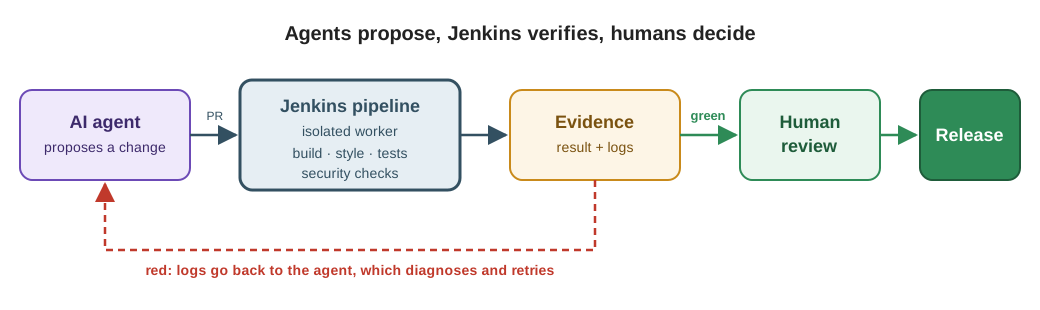
A successful build is not proof that software is flawless, and a green pipeline cannot validate every business requirement. But a passing build is a concrete, repeatable signal that a probabilistic system can’t provide simply by reasoning about its own code.
Optimizing Pipelines for Faster Feedback
Evidence is only useful if it arrives quickly. Agent-driven development can produce more changes and more build cycles, making pipeline latency increasingly visible. Teams should focus on improving their pipelines so agents and developers learn about failures as quickly as possible. Parallel stages, effective caching, targeted tests, and appropriately sized workers can reduce wait times without weakening essential checks. Run fast, high-value checks early, while keeping the full test and release gates in place before deployment.
A simplified declarative pipeline following that pattern could look like this:
pipeline {
    agent none
    stages {
        stage('Fast checks') {
            failFast true // stop the other branches as soon as one fails
            parallel {
                stage('Compile & style') {
                    agent { label 'linux' }
                    steps { sh 'mvn -B -ntp -DskipTests verify' }
                }
                stage('Unit tests') {
                    agent { label 'linux' }
                    steps { sh 'mvn -B -ntp test' }
                }
            }
        }
        stage('Full test suite') {
            agent { label 'linux' }
            steps { sh 'mvn -B -ntp verify -Pintegration-tests' }
        }
        stage('Deploy') {
            when { branch 'main' } // agent branches never reach this stage
            agent { label 'deploy' }
            steps { sh './deploy.sh' }
        }
    }
}
Governance and Auditability: Managing the AI PR Firehose
Shorter feedback cycles make strong controls even more important, as more agent-generated changes may move through the pipeline each day. When agents can open pull requests at scale, review capacity becomes a constraint. More changes also mean more opportunities for mistakes: a leaked credential, a weakened test, or a modification that exceeds the agent’s intended scope.
Jenkins can enforce access controls, scope credentials, integrate with secret managers such as HashiCorp Vault, and sign artifacts. Teams should still limit each agent’s permissions and keep untrusted changes away from privileged environments.
Build records, source control, and provenance tooling help link changes to the agent, pipeline, and resulting artifacts. That audit trail makes it easier to investigate problems and roll back a change when needed.
Bridging AI Agents to Heterogeneous Enterprise Systems
Those safeguards must work across more than a single, standardized toolchain. AI agents often work best with clean interfaces and well-documented services. Enterprise environments are rarely so tidy. A single delivery process may involve legacy systems, multiple cloud providers, Kubernetes clusters, internal tools, and specialized deployment procedures.
Jenkins has long been used to connect such systems through pipelines and plugins. That ecosystem can give teams a head start: instead of building a bespoke integration for every agent and every tool, they can expose existing delivery steps through jobs and pipeline stages.
The Jenkinsfile also offers a useful shared language for agents and humans.
Because pipelines are defined as code, an agent can inspect an existing workflow, propose a change, or generate a pipeline for a new project.
Human reviewers can examine that proposed workflow alongside the application code.
Agent-generated pipeline changes deserve the same testing and review as application code.
The Symbiosis of AI and Jenkins
As AI takes on more implementation work, developers increasingly spend time directing agents, reviewing changes, and deciding what should ship. Agents can help write and modify code, but they still need a reliable way to execute the work and check the result.
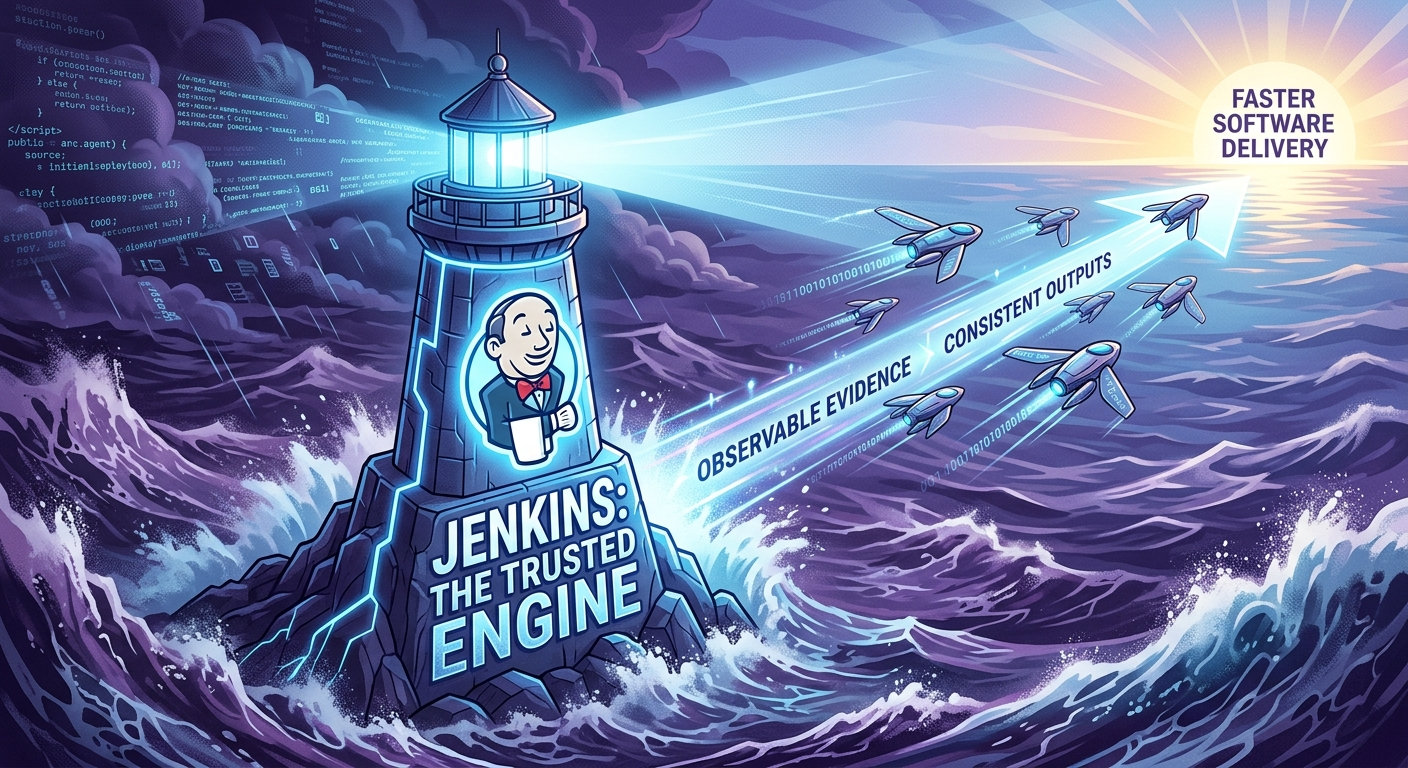
Jenkins provides that operational foundation: repeatable pipelines, integrations with existing systems, and a record of what ran. It doesn’t make agent-generated code correct, and it doesn’t remove the need for human judgment. It makes the path from proposal to verified build more controlled, and that matters, because today’s agents still have to earn our trust. A trusted CI system can provide consistent, observable evidence that helps teams build that trust, serving as a solid rock in a stormy sea of probabilistic outputs.
AI may give teams increasingly autonomous contributors. Jenkins gives them a consistent way to inspect and control the changes they produce.
About the author
I started contributing regularly in 2019, with a focus on improving quality. I’m also keeping up with some older plugins that are still really popular, like the Thin Backup Plugin and the Job Configuration History Plugin. The community helped me to bring these back up to standard and I learned a lot along the way. Furthermore, I use these lessons to make regular improvements to the developer documentation.
In my day job, I’m a solution architect in a central team that provides Jenkins and DevOps consulting within a big automotive and industrial company.