GSoC 2026 Final term: AI Chatbot to Guide User Workflow


Hi everyone 👋,
I’m Daniele, the Google Summer of Code 2026 contributor who worked this summer on creating the AI Chatbot to Guide User Workflow plugin.
The extended period of my project is coming to an end, and I want to share a bit about this brand-new plugin and my journey through GSoC.
About the Project
The plugin integrates an agent-powered chatbot directly into the Jenkins interface. This tool is invaluable for both beginners who need guidance navigating the software and experts who want to quickly troubleshoot a failed build.
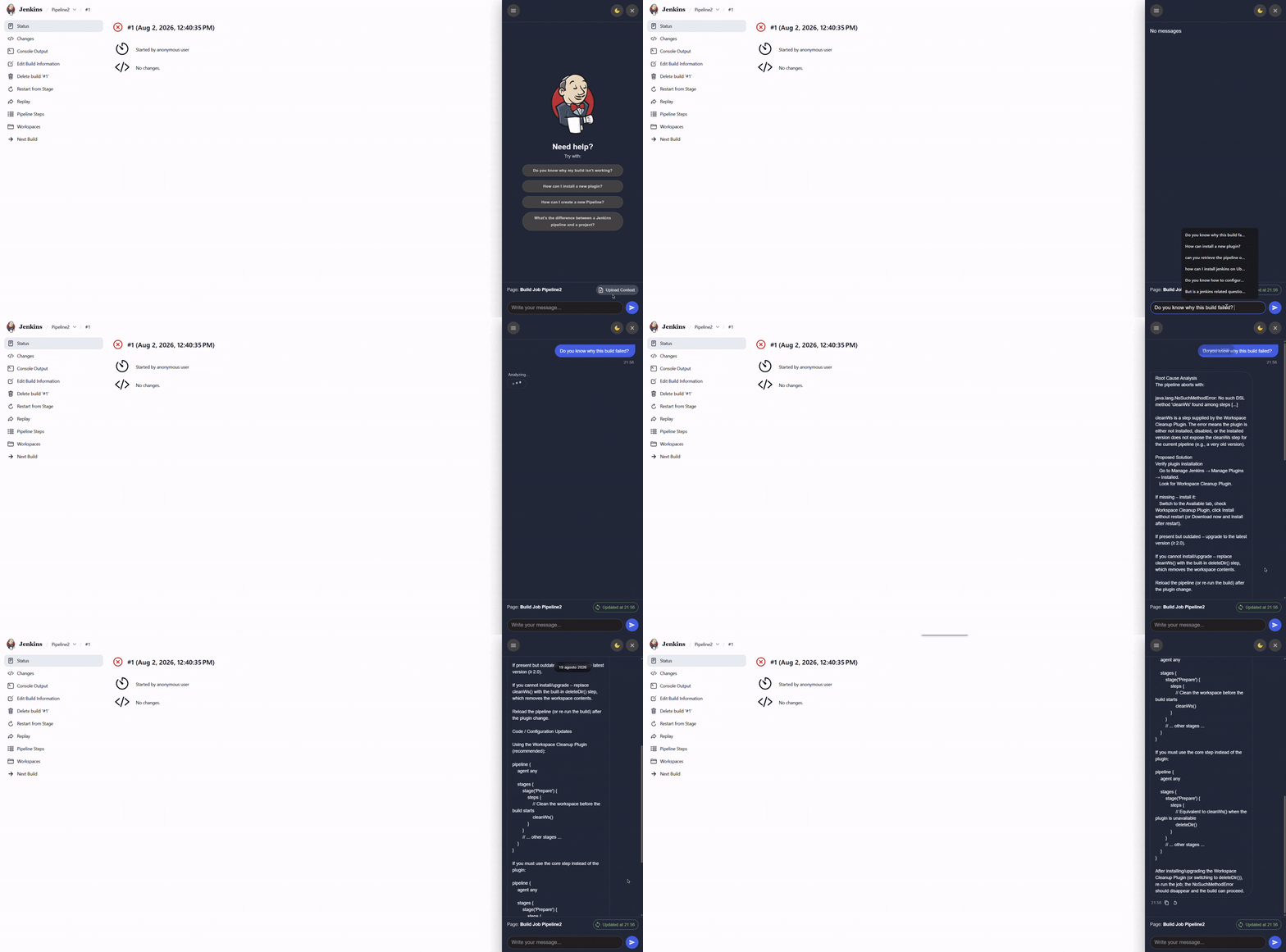
The agent can perform a variety of tasks, including: * Searching the Jenkins documentation and Discourse topics. * Reading Jenkins context data, such as failed build logs or job configurations.
During the first part of GSoC, I worked on the components surrounding the agentic logic: the Data Pipeline, Frontend UI, Hybrid Retrieval, and the communication layer between the frontend and backend.
Second part of GSoC
In this second phase of GSoC, I focused on building the core agent logic and the tools the agent uses to gather Jenkins context information.
The agent logic is powered by LangGraph, and I found that a 20-billion parameter model is more than enough for our needs. In fact, using gpt-oss-20b, the agent can seamlessly search through the logs of a failed build, analyze job configurations, and inspect workspace trees and files to retrieve general Jenkins information. (You can read more about the agent logic here).
I also implemented two advanced, optional features that require more computational resources than the baseline setup:
-
Reranking: Allows the use of a specific reranker model to reorder the documents retrieved from the vector database, maximizing the relevance of the context.
-
Contextual Retrieval: A technique introduced by Anthropic that significantly improves RAG (Retrieval-Augmented Generation) accuracy. You can read more about it here and in the official Claude cookbook.
Additionally, both evaluation tests and observability were integrated into the project. This infrastructure ensures that future developers can easily troubleshoot the agent logic and evaluate any new features added to the agent. (Read more about evaluation here).
Finally, I wrapped up my GSoC journey by thoroughly documenting the project (available on the official documentation site) and implementing End-to-End (E2E) Cypress tests using Docker. These tests are crucial to ensure that the entire architecture works and all components communicate exactly as expected.
My contributions
Here is the list of the Pull Requests I’ve worked on during the program:
The plugin’s future
The plugin will be published soon so that anyone can test it out on their machine. Setup is very straightforward, and I’ve published a guide on how to quickly install and configure it: AI Chatbot Workflow Quick Installation Guide.
In the future, I would love to see the following features added:
-
Frontend UI Markdown support: Currently, the frontend displays Markdown as plain text. Implementing a proper rendering of Markdown text will highly improve readability.
-
"Human-in-the-loop" features: It is fantastic that the chatbot can tell us how to do and fix things, but it would be even better if it could perform actions for us upon request. Changing a specific setting or updating a Jenkins pipeline file automatically without the need to do it manually would be an incredible time-saving feature.
Acknowledgements
Over the past few months, I’ve had the privilege to work for a very important Open Source organization, assisted by my fantastic mentors: Kris Stern, Shivay Lamba, and Chirag Gupta, who guided me through the process of creating this incredible new plugin.
I’m very grateful to the Jenkins Community for this opportunity, and I’m truly happy to be a part of it.
See you soon!
About the author