Navigating My First Jenkins Security Advisory: A Maintainer’s Journey

Navigating My First Jenkins Security Advisory: A Maintainer’s Journey
As a maintainer of the job-config-history plugin, I have always appreciated the community and the robustness of the Jenkins ecosystem. However, recently I had the opportunity to experience a different, and perhaps more critical, side of open-source maintenance: the Jenkins security process.
Back on April 13, 2026, I received a notification in Jira regarding a potential security issue in my plugin. What followed was a journey that taught me quite a bit about the Jenkins core security architecture I wasn’t familiar with.
The Learning Journey
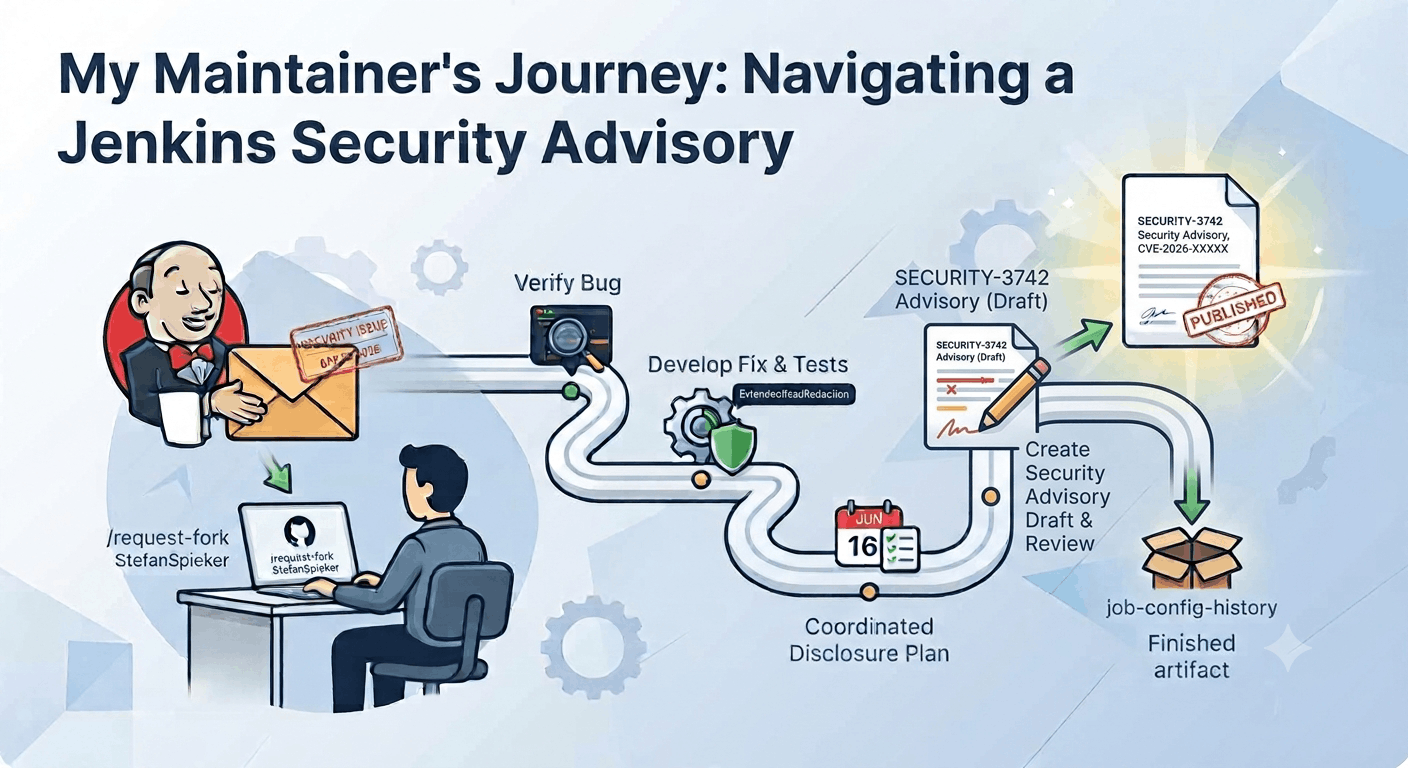
1. Initial Contact and Confidentiality
When I first received the issue, the instructions were clear: keep everything confidential. The issues are handled in a private part of the Jenkins Jira, which is not accessible to the public.
By default, most Jenkins plugins are developed in public repositories on GitHub. Since an unresolved security vulnerability is sensitive, and even acknowledging it publicly can put users at risk, you cannot work on the fix in the public eye.
The /request-fork command triggers the creation of a private repository within the jenkinsci-cert GitHub organization.
This organization is reserved for security-sensitive work.
I promptly ran /request-fork StefanSpieker to get access to a private repository.
A nice automation then gave me access to the private fork of my plugin, where I could work on the fix without exposing the details to the public.
Since the private fork was created some time ago, before I was added as a maintainer, the state of the code was not up to date with the public repository.
The automation does not take care of syncing the private fork with the public repository and kept the private fork in its original state.
It took me a moment to realize my fork was essentially a time capsule; catching up with the present became my first hurdle.
2. Understanding the Issue
Once I got the environment set up and verified the security issue, which was indeed real, I began the work of crafting a fix. My first attempt was, admittedly, a bit naive. The security team’s feedback was immediate and educational (shortened for brevity):
This is too narrow.
Use ExtendedReadRedaction, an extension point in core.
3. Admitting the Complexity
This was a turning point for me. I had to pivot from a quick patch to implementing a more robust, core-integrated solution. Between balancing family life and my regular professional responsibilities, it was a process of iterative improvement. I spent weeks refining the code, writing tests, and responding to feedback from Daniel Beck and Kevin Guerroudj, who guided me through the intricacies of the fix. Although I was not always able to respond immediately, the security team was patient and supportive.
By mid-June, after a few rounds of revisions, the fix was finally complete and approved. Then came the administrative side: the coordinated disclosure.
4. Getting Ready for Disclosure
On June 16, I received a detailed roadmap from the security team, outlining the path to the June 24 security advisory. One of the most reassuring aspects of this experience was the support provided. When asked who would perform the release, me or the security team, I chose the latter. I opted to let Kevin handle the staging and technical release heavy lifting.
Watching the process unfold was fascinating. The security team locked the default branch, generated the artifacts, and drafted the advisory. I was able to review the final advisory text on June 23, and by June 24, 2026, the update was live and the security advisory was published.
Reflections
Looking back, I am grateful for the process. While receiving a security report for a plugin you maintain can feel daunting, the Jenkins security team turned it into an educational experience.
Plugin Insight
I understand the internals of my plugin far better now than I did when I first adopted it.
Core Knowledge
I gained valuable experience with Jenkins' security mechanisms, like ExtendedReadRedaction.
The Power of Collaboration
The security process is not just about patching code; it is a well-oiled machine designed to protect users while supporting maintainers.
If you are a maintainer, and you receive a security issue notification, do not panic. Engage with the team, follow the provided documentation, and treat it as an opportunity to harden your plugin and learn from some of the best in the industry.
Have you ever navigated a security disclosure for an open-source project, or are you interested in becoming a plugin maintainer yourself?
About the author
I started contributing regularly in 2019, with a focus on improving quality. I’m also keeping up with some older plugins that are still really popular, like the Thin Backup Plugin and the Job Configuration History Plugin. The community helped me to bring these back up to standard and I learned a lot along the way. Furthermore, I use these lessons to make regular improvements to the developer documentation.
In my day job, I’m a solution architect in a central team that provides Jenkins and DevOps consulting within a big automotive and industrial company.