Introducing Smart Retry: Safer retries for transient Jenkins failures.
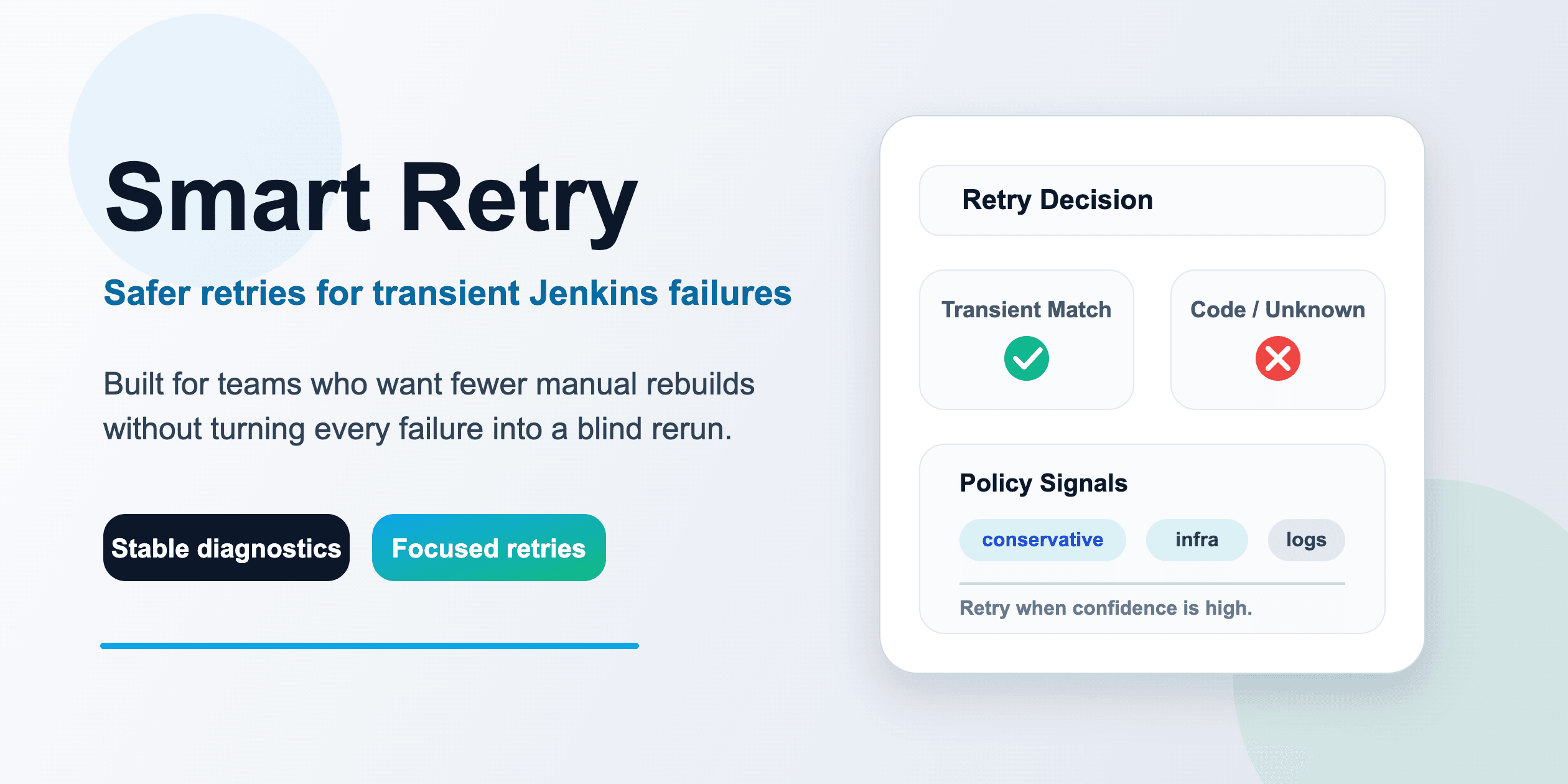
In many Jenkins environments, a failed build does not always mean the code is broken.
Sometimes a Kubernetes agent gets evicted. Sometimes a Git fetch is interrupted. Sometimes an artifact repository has a short outage. In all of these cases, the next manual rebuild often succeeds.
smartRetry is designed for exactly this kind of CI problem: transient failures that are worth retrying, without turning every failed step into an automatic rerun.
What is Smart Retry?
smartRetry is a Jenkins Pipeline step that retries only the failures worth retrying.
Instead of rerunning a failed block unconditionally, it classifies the failure first and then decides whether a retry is allowed under the active profile.
For example:
smartRetry(profile: 'infra', maxRetries: 2, backoff: 'exponential') {
  sh 'mvn -B verify'
}
When the wrapped step fails, smartRetry will:
-
Capture the thrown error and a bounded slice of console output from the current attempt.
-
Classify the failure into a deterministic category such as
AGENT_LOST,SCM_TRANSIENT,NETWORK_TRANSIENT,COMPILATION_FAILURE, orUNKNOWN. -
Check whether that category is retryable under the active profile.
-
Log the decision clearly and schedule another attempt only when the policy allows it.
This keeps retry behavior explicit, deterministic, and easier to understand.
Why use Smart Retry?
The main idea behind smartRetry is simple: classify first, retry second.
That lets the plugin stay conservative by default. It can automatically recover from high-confidence transient infrastructure problems while still failing fast on deterministic issues such as:
-
compilation failures
-
Pipeline script logic errors
-
UNKNOWNfailures that do not match a high-confidence rule -
user-initiated aborts
For day-to-day CI, those defaults work well because the retry decision remains visible and explainable.
How it works
1. Configure Smart Retry globally
After installing the plugin, you can configure shared defaults in Manage Jenkins > System, including:
-
the default profile
-
the default maximum retry count
-
fixed or exponential backoff
-
custom profiles
-
narrow custom classification rules
The current built-in profiles are:
-
conservative: retries onlyAGENT_LOSTandSCM_TRANSIENT -
infra: includesconservative, plusNETWORK_TRANSIENT,ARTIFACT_REPO_TRANSIENT, andIDENTITY_PROVIDER_TRANSIENT
If you are introducing automated retries to a team for the first time, conservative is the safest place to start.
2. Use it in a Jenkinsfile
The simplest pattern is to wrap steps that are idempotent and exposed to infrastructure volatility.
For example, around checkout:
smartRetry {
  git branch: 'main',
      credentialsId: 'scm-creds',
      url: 'https://gitlab.example.com/your-group/your-repo.git'
}
Or around a build step that depends more heavily on external services:
smartRetry(profile: 'infra', maxRetries: 2, backoff: 'fixed', initialDelaySeconds: 10) {
  sh 'mvn -B verify'
}
As a general rule, keep the wrapped block as small and as idempotent as possible. That reduces risk and makes retry behavior easier to understand.
3. Inspect the decision
Another key part of smartRetry is explainability.
When a build fails, it does not just say "retrying".
It logs the classification, the decision, and the reason.
For example:
[smartRetry] begin attempt=1
[smartRetry] attempt=1 profile=infra classified=SCM_TRANSIENT retryCandidate=true decision=RETRY nextAttempt=2 delayMillis=10000 reason="Failure type SCM_TRANSIENT is retryable under profile infra and retry budget remains."
[smartRetry] begin attempt=2
Each build that uses smartRetry also gets a dedicated Smart Retry page showing:
-
the active profile
-
the classification result for each attempt
-
which rule matched the failure
-
whether the build recovered or stopped retrying
This is especially useful when you need to answer "why did this build retry?" or "why did it stop here?".
Conservative by design
smartRetry is not trying to turn Jenkins into a system that guesses its way through every failure.
The current implementation keeps a few boundaries on purpose:
-
no AI-based failure classification
-
no retry on
UNKNOWNby default -
no retry on compilation failures, Pipeline logic failures, or user aborts by default
-
no deployment-style failure retry in the default policy
That may sound less ambitious than "intelligent retries for everything", but it is often a better fit for real CI systems where safety and predictability matter.
Where Smart Retry fits best
smartRetry is a good fit for:
-
Jenkins installations running on Kubernetes or other ephemeral agents
-
checkout steps frequently affected by Git or SCM transport instability
-
Pipeline steps that depend on Maven, npm, PyPI, Docker registries, Artifactory, or other external services
-
teams that already know a manual rebuild often succeeds, but do not want to retry every failure blindly
It is not meant to replace every use of retry {}, and it is not a default wrapper for non-idempotent release or deployment steps.
Try it
If your Jenkins environment regularly sees lost agents, SCM hiccups, or short-lived dependency service outages, smartRetry is worth trying in a small and controlled scope.
Start with the conservative profile, use it around idempotent steps such as checkout or dependency download, and expand to infra only after you have seen how it behaves in your own environment.
For many teams, the goal is not another blind retry, but a safer way to retry only when it actually makes sense.
The project is open source on GitHub: jenkinsci/smart-retry-plugin.
If you have a transient failure pattern that should be covered, or you want to help improve the built-in rules, issues and pull requests are very welcome.