Impressions from Jenkins Stand at FOSDEM Brussels

Two Days Behind the Jenkins Booth at FOSDEM 2026
FOSDEM is always a blur. Two days, hundreds of conversations, one booth, and just enough coffee and beer to get through the weekend.
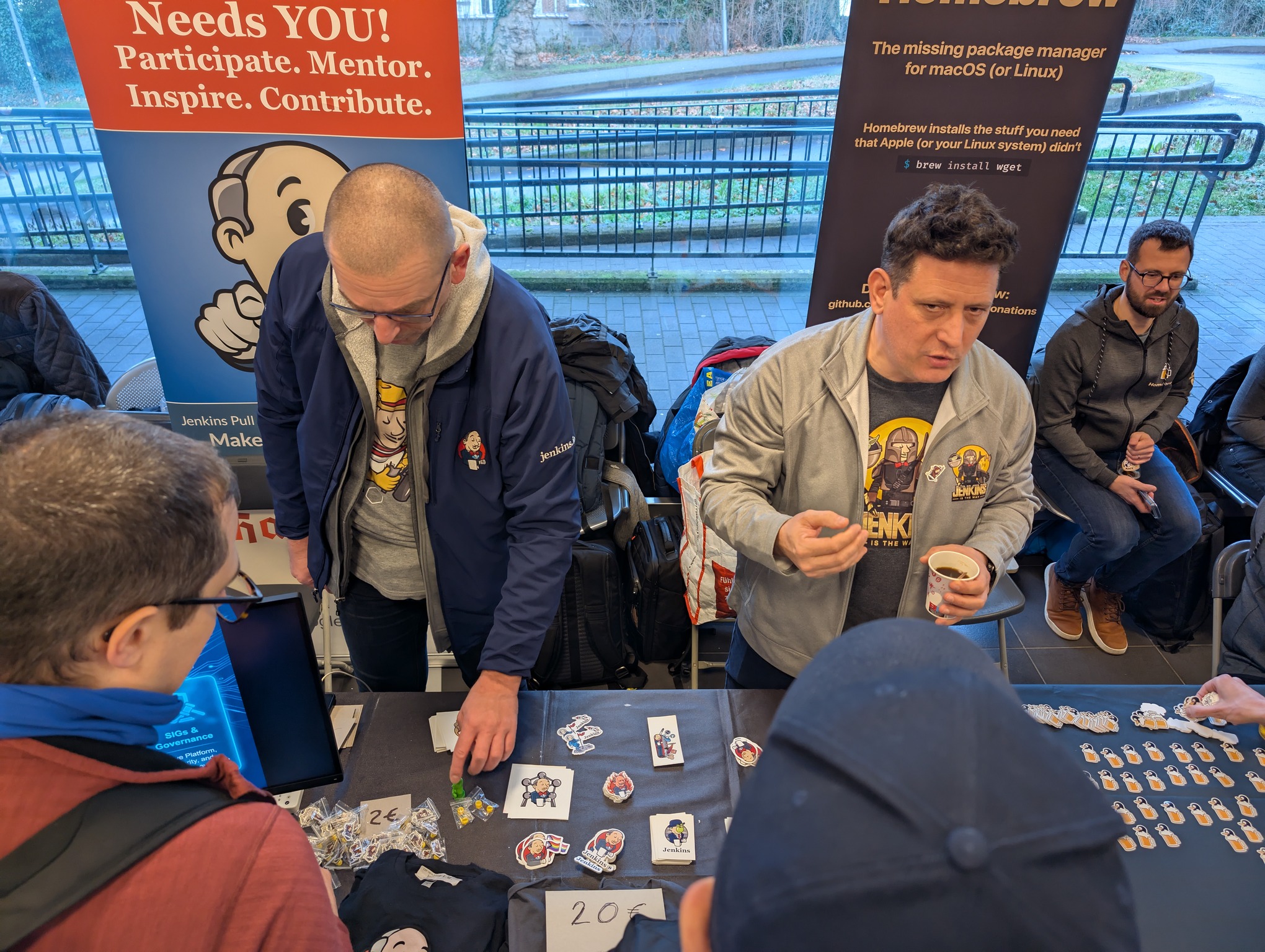
This year at FOSDEM 2026, I had the privilege of standing behind the Jenkins booth. If you’ve ever wondered what it’s like on the other side of the table at one of the busiest open source conferences in Europe — here’s a field report.
The Visitor Archetypes
After about 50 conversations, patterns emerge. By the end of day two, you can almost predict the opening line.
1. The “I Just Wanted to Say Thank You” Visitor
They don’t want stickers. They don’t want to debate YAML vs Groovy.
They just walk up and say:
“Hey, I’ve been using Jenkins for years. Thank you.”
Some run builds for research labs. Some ship medical devices. Some maintain internal tooling for companies you’ve definitely heard of.
They’ve been quietly relying on Jenkins for a decade or more. No drama. Just pipelines running at 2am.
These conversations are short — but they’re the ones you carry home.
2. The “Wait… Blue Ocean Is Being Deprecated?” Crowd
This one starts with excitement:
“I love Blue Ocean!”
And then we gently explain the status of Blue Ocean.
Cue visible surprise.
Blue Ocean was a bold experiment in rethinking the Jenkins UX. It brought modern pipeline visualization to a platform that predates most current frontend frameworks. But maintaining a parallel UI stack long-term is hard — especially in an open source project driven by volunteers.
The common reactions:
“Oh… I didn’t know.”
“What should I use instead?”
“Is there something new coming?”
Which leads directly to…
3. “Have You Heard of Pipeline Graph View?”
Short answer: probably not. Long answer: that’s part of the problem.
Pipeline Graph View is the modern, actively maintained visualization for Jenkins pipelines. It’s lighter, integrated into the main UI direction, and not trying to be an entire alternative universe.
Yet over two days, most people who loved Blue Ocean had never heard of it.
This is the classic open source paradox:
We built the thing. We shipped the thing. But communicating the thing? That’s harder than merging the PR.
If you’re still associating Jenkins pipeline visualization exclusively with Blue Ocean, it might be time for another look.
4. Groovy Pipeline Confessions
Some conversations begin in a whisper:
“I… may have abused scripted pipeline.”
We heard it all: 2,000-line Jenkinsfiles
Groovy is powerful. Maybe too powerful.
But here’s the interesting part: these weren’t complaints. They were confessions from people who pushed Jenkins to its limits — and sometimes beyond — because it let them.
Declarative pipelines helped. Shared libraries helped. But the raw flexibility of Groovy remains both Jenkins’ superpower and its chaos engine.
And we love you for using it creatively. Even if we gently recommend refactoring.
5. The Angry Butler Sticker Phenomenon
We brought stickers. Lots of stickers.
One clear winner:
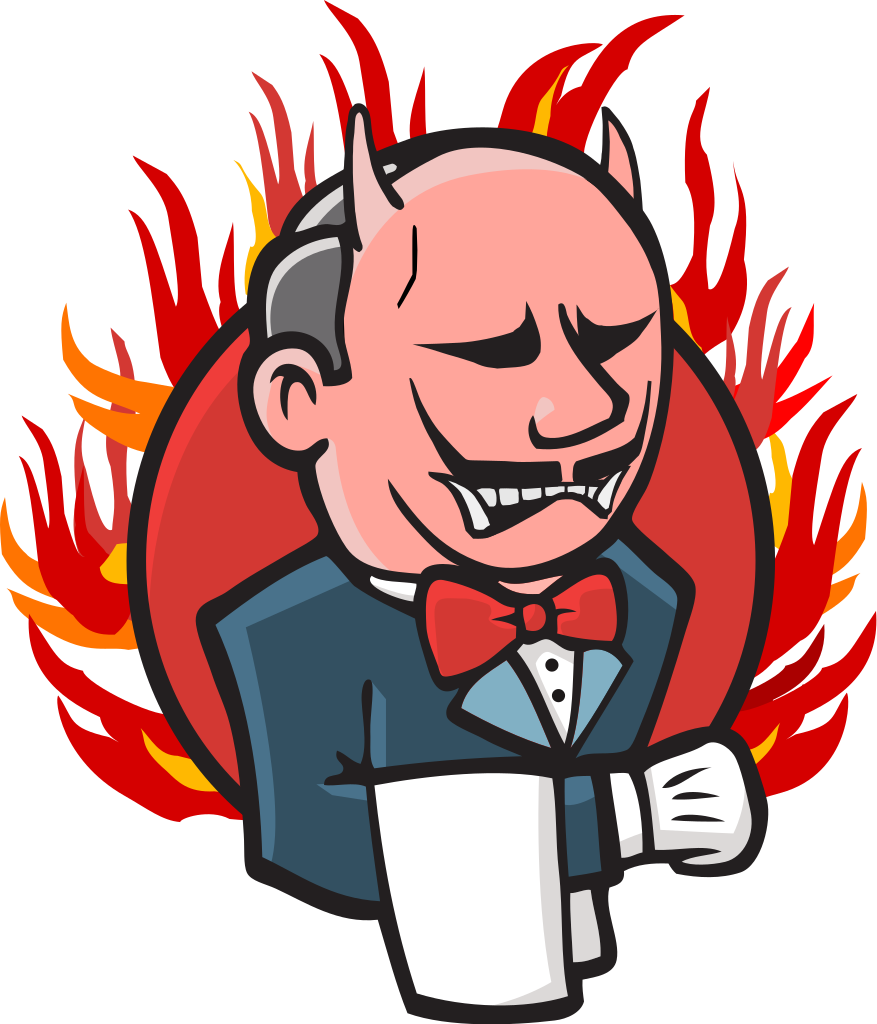
It turns out that an anthropomorphic CI server expressing mild frustration is extremely relatable.
There’s something deeply honest about a slightly annoyed butler judging your broken build.
6. Our Neighbors: GitLab
Right next to us: GitLab.
You might expect rivalry vibes. Instead? It was refreshingly friendly.
We traded stickers. We compared notes on visitor questions. We laughed about shared CI/CD pain points.
At the booth level, it wasn’t “us vs them.” It was: “CI is hard. Solidarity.”
Open source ecosystems overlap more than marketing pages suggest. Many people run hybrid setups. Many teams experiment. The lines are blurrier than Twitter debates imply.
And honestly? The GitLab folks were pretty cool.
Everywhere AI
If FOSDEM 2026 had a background soundtrack, it would be:
“Does it use AI?”
Every hallway track, every devroom, every booth.
So yes — Jenkins conversations also drifted there.
Which made this especially relevant:
The Explain Errors Plugin
If you haven’t seen it yet, check out the Explain Errors Plugin.
The idea is simple: When your pipeline fails, you don’t just get a stack trace. You get help understanding it.
That’s the kind of AI integration that feels aligned with CI/CD: Practical. Contextual. Opt-in.
Not replacing engineers. Helping them get unstuck faster.
Behind the Booth: Learning the Ropes
A booth doesn’t run itself.
Before FOSDEM, I had no idea how much choreography is involved: sticker logistics, demo rotations, handling tough questions, knowing when to go deep and when to keep the line moving.
Huge thanks to Bruno Verachten and Stephane Merle for patiently teaching me how to operate the booth — from the practical details to the subtle art of engaging passersby without overwhelming them.
If I looked like I knew what I was doing, it’s because I had excellent teachers.
What Two Days Behind the Booth Teaches You
Jenkins is still everywhere.
Communication is as important as code. Special thanks go to everyone who stopped by to share their stories, ask questions, and give feedback.
Stickers matter more than you think.
Open source is powered by humans showing up in person.
FOSDEM compresses an entire year of GitHub issues into two days of real conversations.
And behind the booth, between sticker handoffs and pipeline debates, you’re reminded:
Jenkins isn’t just a server. It’s a community that keeps shipping.
See you next year.
About the author
I started contributing regularly in 2019, with a focus on improving quality. I’m also keeping up with some older plugins that are still really popular, like the Thin Backup Plugin and the Job Configuration History Plugin. The community helped me to bring these back up to standard and I learned a lot along the way. Furthermore, I use these lessons to make regular improvements to the developer documentation.
In my day job, I’m a solution architect in a central team that provides Jenkins and DevOps consulting within a big automotive and industrial company.